Abstract
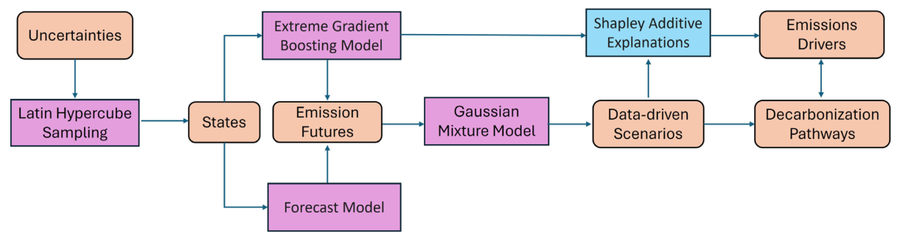
In this work, we applied scenario discovery to explore emission reduction potentials and identify decarbonization pathways over multiple sectors, using the New Haven-Milford Metropolitan statistical area as a case study in regional planning. We first generated a diverse set of future emission states using Latin hypercube sampling (LHS), and then applied Gaussian mixture modeling to cluster outcomes based on emission percentage changes between 2021 and 2050 (EPC) and cumulative emissions percentage change (CEPC). This analysis identified four decarbonization scenarios: Mild, Moderate, Deep, and Near Net-Zero. We further examine the pathways associated with these decarbonization scenarios and the parameter combinations that could drive progress toward the decarbonization targets, as well as shifts in the relative importance of these activity parameters under different target-year assumptions. The results indicate that achieving Near Net-Zero requires parameter shifts exceeding 50% of their feasible sampled ranges for electrification rates, fuel economy (MPG), truck vehicle miles traveled (VMT), and commercial emissions, as well as earlier action in achieving this transition. Furthermore, we trained an eXtreme Gradient Boosting (XGBoost) model to predict EPC and CEPC. XGBoost model revealed the most relevant factors in each scenario. In particular, residential natural gas consumption is a key driver of emissions reduction in Near-Net Zero, followed by commercial emissions, highlighting an effort to improve the efficiency of residential and commercial building energy consumption. Overall, we demonstrate that not only the level of reduction of each activity parameter is important for emissions reduction, but also the pace of the parameter change over the prediction horizon.